
Get To Know Our Coaches: Timothy Achumba
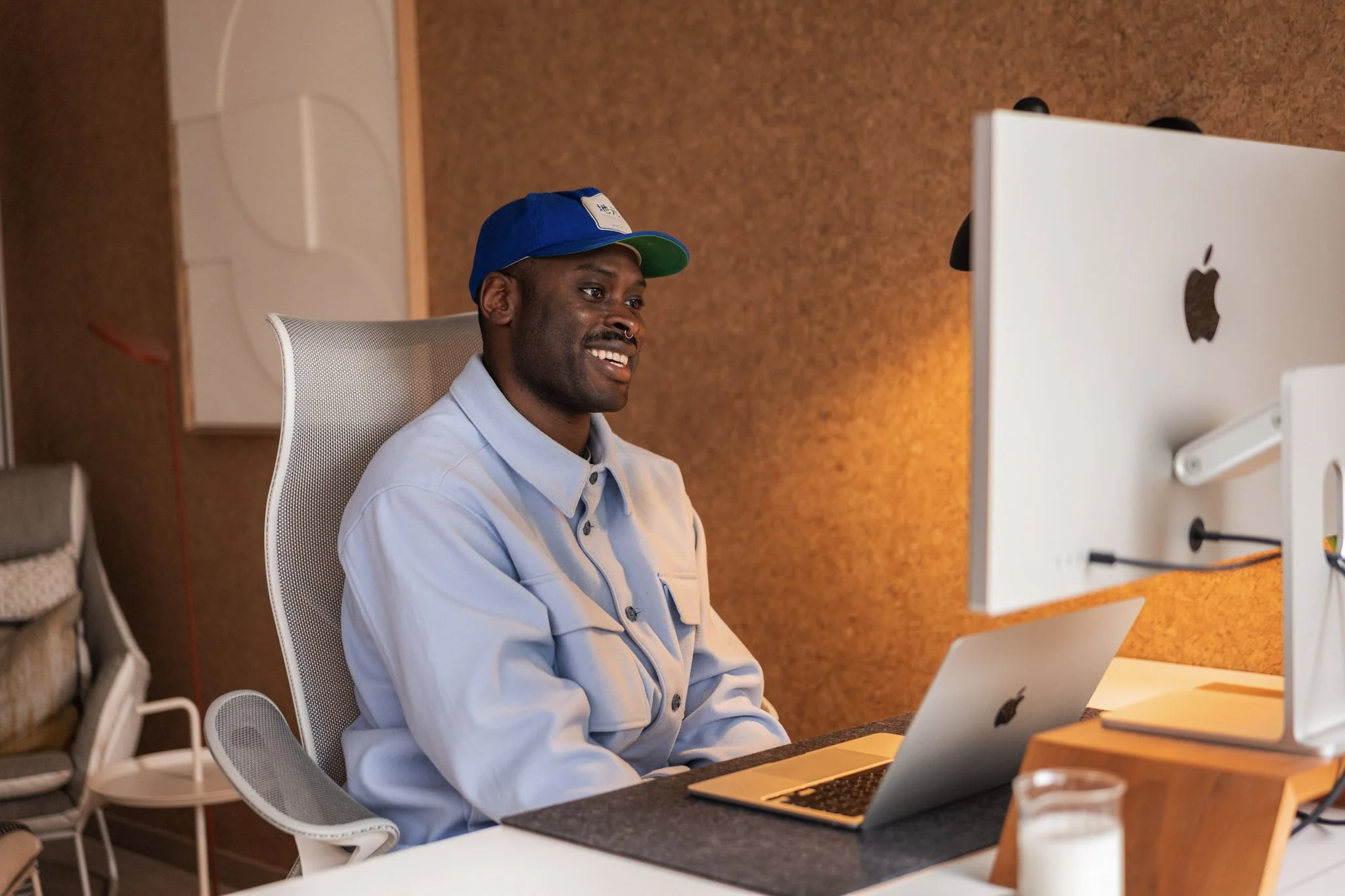
Timothy Achumba in a video coaching session
Timothy is a Design Director at Microsoft where he leads an AI-focused design lab. In his coaching with Good Maven, he helps designers find the clarity and confidence their work deserves.
We sat down with Timothy to talk through his career, which spans from individual contributor to hiring manager to design leader. He digs into what it means to design with AI rather than just for it, why taste matters more than ever, and how he helps senior designers tell a sharper story about their own work.
Good Maven: You're a designer, a maker, and a writer all at once. How did you first find your way into design?
I was always into computers, going to computer fairs with my dad to buy parts and build machines at home. I grew up in a Windows house but was secretly obsessed with Macs, and I'd install skin apps to fake a Mac dock on my PC. I was probably the one in my family who understood computers the deepest.
My first real design work was making flyers for my dad's church at 14 or 15, using Microsoft Publisher because I didn't have Photoshop and didn't even know bootleg copies existed. Seeing that people actually found use in something I made, even at that small scale, was the first time design felt like it had real impact. From there I moved to designing the church website. I still didn't have Photoshop, so I hacked together graphics by drawing them in PowerPoint and using its export-to-PNG feature, then bringing them into Dreamweaver to build the site. A friend later pointed me toward WordPress, and I taught myself PHP mostly through Stack Overflow. That whole path, flyers to websites to WordPress, is what pulled me from web design into thinking about software and apps more broadly, with a focus on beauty and interaction.
GM: Your early years took you through Mobedia, Wunderlist, and Meta. What did that stretch teach you?
Mobedia is where I learned to separate my identity from my work, to not take critique as a reflection of who I am, and it's also where I actually built my craft: Photoshop, skeuomorphic* realism, lighting, shadow, blend modes. Wunderlist was my first real product design role, and where I learned UX, motion, and interaction design properly, working inside a real design team. I'd moved to Berlin at that point, living on my own for the first time. Wunderlist was acquired by Microsoft, and that taught me a different lesson: how to move from a small company's own culture into a large organization, and that real influence comes through collaboration and engagement, not from insisting your way is the right way.
Meta is where I got genuinely intentional about my career, a performance-driven environment that pushed me to think clearly about impact and how to get there in deliberate steps, which was empowering rather than stressful. I fell in love with prototyping, especially prototyping with data, using Origami constantly. I was working in ads, which wasn't naturally my interest, but I found a way to be passionate about the work through how I did it: building, experimenting, growing my craft.
*Skeuomorphic design makes digital items look like real-world physical objects. It uses textures, shadows, and 3D shapes so software tools act and feel familiar.
GM: What brought you to Good Maven?
Meg hired me back when I joined Facebook, and we stayed in touch after I left. When she reached out about building something new and asked if I'd want to be part of it, it felt like an easy yes. What drew me in specifically was the way she approaches people, seeing the individual and placing value on them, rather than treating people like a line on a spreadsheet. That has always matched how I see the world.
GM: You now lead an AI-focused design lab at Microsoft. How did you end up at the intersection of design and AI, and what drew you there?
Honestly, when this started I assumed it was another metaverse or blockchain-style wave that would pass. What changed my mind was trying to actually design for it, not just use it, and feeling the material itself shift under me. It doesn't hold still the way a normal design problem does, and I couldn't build the same confidence in my process that I used to have. That pushed me to start advocating loudly for designing in code, for changing how we work if we want to build these kinds of experiences.
That led to a conversation about building a team, and since I'm remote in the UK, it made sense to center it in the European time zone. The idea was a group doing more speculative work, figuring out how this technology could apply, without the pressure of an aggressive roadmap. I never set out to become a manager, I've always wanted to be an individual contributor, a maker. This role actually lets me be both. Most of my days are still spent building and experimenting directly, alongside a genuinely great team.
What makes this work interesting is the license it gives us to question thirty or forty years of software design assumptions that were shaped by old technological limits. We finally have the capability to go back to first principles, grounding ourselves in research about how people think and behave, instead of leaning on the layers of design patterns we've built up over time.
GM: How are you seeing AI shape design careers? What do you want designers to know about how the industry is changing?
I don't think the role of design has fundamentally changed, we've always had to learn new tools and paradigms as technology moved. What has genuinely shifted is using AI to design, not just designing for it. Our ability to ideate has grown enormously, we can visualize and experience an idea in minutes that used to take days or weeks. That speed is real, but it puts more weight on judgment, not less. Just because we can make something doesn't mean we should, and deciding what's worth making and how it should work matters more now. Building your own internal compass, and resisting the pull of surface-level AI polish, is a big part of the work.
There's a bigger question underneath that too: are we designing things that augment human thinking, or replace it? There's a paper I like called “Protecting Human Cognition in the Age of AI” by Singh, Taneja, Guan, and Ghosh, that gets at this well, the risk of what they call metacognitive laziness, where relying on AI's fast, confident answers can erode the effortful thinking that actual understanding depends on. It's worth thinking about alongside what we already know about social media's effects on younger generations. There's no stopping this the way there was no stopping that, so the real question is what role we play in shaping it for good.
GM: When did you start to realize that helping other designers grow was something you wanted to make a real part of your work?
It became concrete for me after I came back to Microsoft. I worked with a designer who'd joined as a contractor, trying to figure out how to land a full-time role and how to grow inside a large organization; how to get noticed, how to have impact. We talked a lot about horizontal impact, the idea that your work matters most through how it influences other people's work, not just your own output. Years later, seeing him leading a team and setting direction for his own product has been genuinely amazing to watch.
GM: Who do you typically work with, and what does someone usually arrive with when they come to you?
Mostly senior designers trying to make the jump to principal or staff. They usually arrive with substance, strong raw material, but not the right narrative around it. So, we work on shaping that story: how to advocate for themselves at their company, how to tell a sharper story in a portfolio or interview, how to sharpen their craft, and increasingly, how to actually use AI well in their own workflow.
GM: What do you help people figure out, and what do you think you bring that's distinctive as a coach?
Most people underestimate their own experience. A lot of what I do is help them see that clearly and shape the narrative around their work into something more honest and accurate, which usually means it's more impressive than they gave themselves credit for. What I bring to that is having sat in a lot of different chairs, since I’ve been at large companies and startups, an individual contributor and hiring manager. I've also been deliberately intentional about my own career for close to a decade now, and I bring what's worked for me, and what hasn't, into how I help people think about their careers. Like most designers, I care about craft, how something looks and feels, which means it's common ground I can meet people on right away, and from there help contextualize that care in terms of the business it needs to serve. Good design is good for business.
GM: What would you say to someone who's on the fence about working with a coach?
We all have blind spots we can't see past on our own. If you're struggling to get your manager to see the value of your work, or your portfolio feels strong but interviews aren't landing, or you just don't have a clear picture of what's next, that's usually not a sign you're doing something wrong. It's a sign you need someone who's been down a similar road to help you see what's already there and get you past that stage. We're not meant to do this alone, at work or otherwise.
GM: Anything else you’d tell someone about design today?
Design feels uncertain right now, but I actually think our role has gotten clearer. These tools have raised the floor. Now anyone can create, anyone can imagine, and that's great. But that means we have to raise the ceiling too: taste, judgment, the eye to actually see a problem and conceive of a solution. Those skills matter more now, not less. My hope is that designers lean into what they've built over their careers rather than second-guess it, especially now, in a moment where creation itself has become so commodified.
If you’d like to book a coaching session with Timothy, tap the button to go straight to his calendar.
Unsure if coaching is quite right for you? Our online guide may be a great aide. Answer a few short questions and we’ll make a recommendation. No data capture!
Learn more about the coaching packages offered by Good Maven. Many of our clients book sessions for their entire teams.